
The Complete Guide to Replacing a Missing Tooth in Guelph: Dental Implants
Medically reviewed by Dr. Michael Bull, DDS, owner and general dentist at Westwood Dental Group · Last updated: October, 2026

A missing tooth is easy to ignore, especially if it's at the back where no one sees it. But a gap changes more than your smile. This guide walks you through what happens when a tooth isn't replaced, how your options compare, and what dental implants really cost at Westwood Dental in Guelph.
Quick answer: When a tooth is lost, the jawbone under it starts to shrink, nearby teeth can drift into the gap, and chewing gets harder. A dental implant is the only option that replaces the tooth's root as well as the crown, which helps protect the bone. Implants cost more up front than a bridge or denture, but they're designed to last for decades, and payment plans can spread out the cost.
What happens if you don't replace a missing tooth?

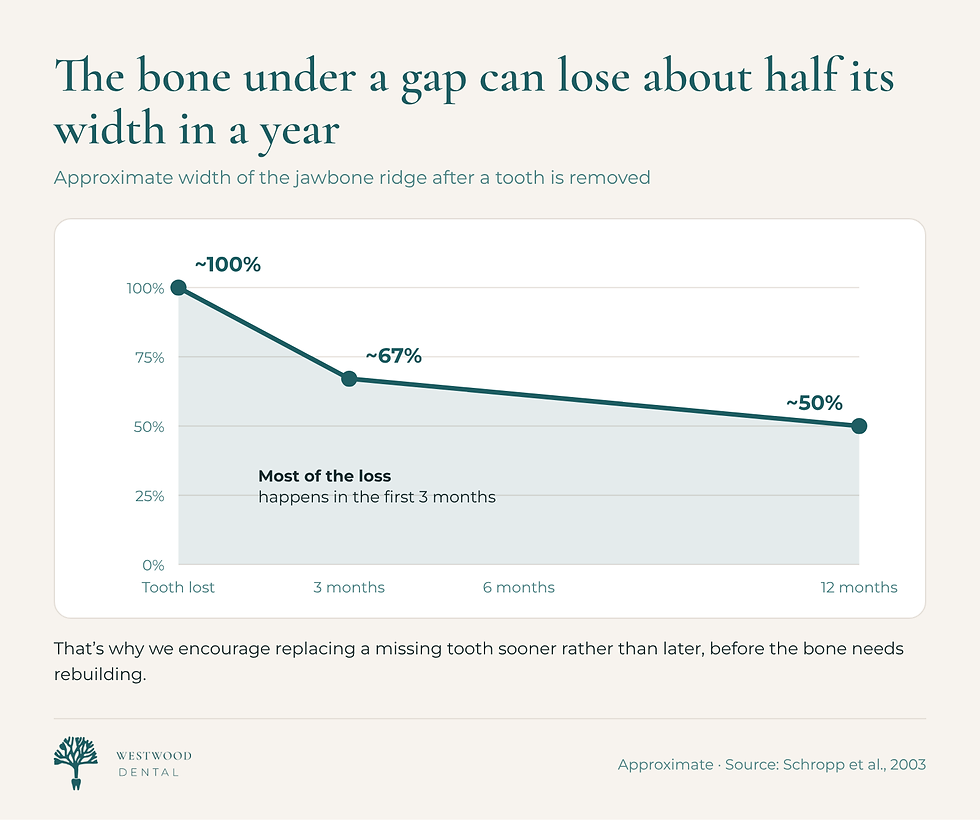
1. The jawbone starts to shrink. A tooth root keeps the bone around it busy. Without one, the body slowly reabsorbs that bone. In one well-known study, the ridge of bone lost about half its width in the year after a tooth was removed, with most of that loss in the first three months.
2. Neighbouring teeth drift. Teeth next to the gap can tip into the space, and the tooth above or below can drift toward it. That can change your bite and create spots that are hard to clean.
3. Chewing gets harder, and diet can change. People with fewer natural teeth tend to eat fewer crunchy vegetables and less fibre, and in one large U.S. study they had lower levels of nutrients like vitamin C and folate. Your mouth is the start of your digestion, so this is a whole-body issue.
4. Your face can change over time. As bone shrinks, especially when several teeth are missing, the lips and cheeks lose support, which can make the face look older or sunken.
5. It gets more complicated the longer you wait. Less bone can mean needing a bone graft before an implant can be placed.
Dental implants vs. bridge vs. denture: which is best?

At a glance:
Dental implant: the only option that replaces the root as well as the tooth, protects the jawbone and leaves nearby teeth alone. It costs the most up front but is designed to last decades.
Bridge: fixed and natural-feeling, but the teeth beside the gap are filed down to hold it, and it often needs replacing after 10 to 15 years.
Removable denture: the lowest up-front cost, but it can move when eating, doesn't protect the bone and usually needs relining or replacing every few years.
The cheapest option isn't always the least expensive. A bridge or denture costs less today, but it may need to be replaced several times over your life, and it doesn't stop the bone from shrinking. An implant costs more up front but is built to be a long-term solution.
What is a dental implant?
An implant is a small titanium post placed in the jawbone, where it bonds with the bone over a few months. A connector (abutment) and a custom crown go on top. Because it acts like a root, it gives the bone a job again.
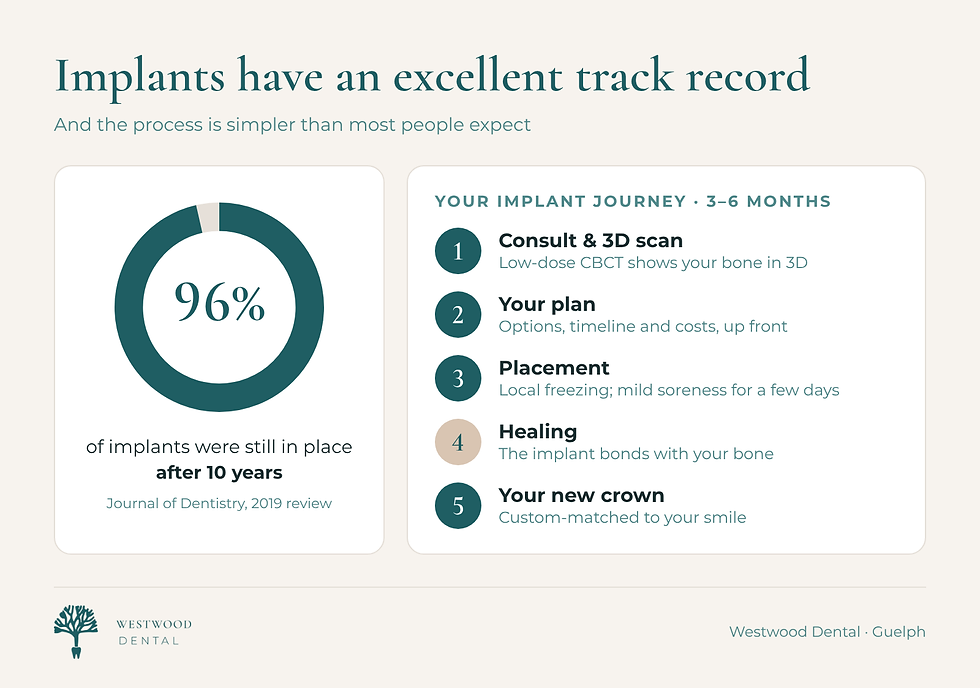
Implants also have an excellent track record: a 2019 review found about 96% of implants were still in place after 10 years (Journal of Dentistry).
See real results in our Smile Gallery.
What does a dental implant cost?
At Westwood, the cost of a single implant (post, abutment and crown) depends on your situation, and we'll give you an exact quote at your consultation before any treatment begins. Your cost depends on:
How many teeth you're replacing, and whether a bridge or denture is supported by implants
Bone grafting, if the bone has shrunk and needs rebuilding first
Extractions, if a damaged tooth needs to come out first
The crown and any other work needed
Making it affordable:
Insurance: some plans cover part of the implant or crown. We can send a pre-determination to your insurer so you know what's covered before you start.
Payment plans: we offer plans through iFinance, with instant pre-approval, no down payment and flexible terms. See your options.
Clear pricing: we review your plan and costs with you before any treatment begins.
What is the dental implant process at Westwood?
Consultation and 3D scan. A quick, low-dose CBCT scan shows us your bone in 3D so we can plan precisely.
Your personal plan. We go over your options, timeline and costs.
Implant placement. The post is placed with local freezing. Most people feel mild soreness for a few days.
Healing. Over a few months, the implant bonds with the bone.
Your new crown. A custom crown is attached, matched to your other teeth.
Most treatment takes 3 to 6 months, mostly healing time. A bone graft adds time.
Frequently asked questions
What happens if I don't replace a missing tooth? The jawbone under the gap starts to shrink, nearby teeth can drift, and chewing can get harder. The longer you wait, the more likely you'll need a bone graft before an implant.
Is an implant better than a bridge? An implant replaces the root, protects the jawbone and doesn't involve the neighbouring teeth. A bridge costs less up front but relies on filing down the teeth beside the gap and often needs replacing after 10 to 15 years.
How much does a dental implant cost in Guelph? The cost depends on how many teeth you're replacing and whether you need a bone graft or extraction first. At Westwood, we give you an exact quote at your consultation, and payment plans are available through iFinance.
How long do dental implants last? With good care, implants are designed to last for decades. A 2019 review found about 96% were still in place after 10 years.
Does getting an implant hurt? The implant is placed with local freezing. Most people feel mild soreness for a few days, which over-the-counter pain relief usually handles.
Am I too old for an implant? There's no upper age limit. What matters is your general health and bone, which a 3D scan helps us check.
Have another question? Browse our dental FAQ or read more about dental implants at Westwood.
Related reading:
About the reviewer: Dr. Michael Bull, DDS, is the owner and a general dentist at Westwood Dental in Guelph. He earned his Doctor of Dental Surgery from the New York College of Dentistry and gained extensive clinical experience at Kings County Hospital in Brooklyn. He has a special interest in airway health, oral function and whole-body wellness.
Also on our implant team: Dr. Willie Cygelfarb, DDS, is a general dentist at Westwood Dental. He earned his Doctor of Dental Surgery from the University of Toronto, where he received the Canadian Dental Association Award of Excellence, and continues to expand his skills through advanced training in dental implant treatment.
Ready to close the gap? Book an implant consultation with Dr. Bull, Dr. Cygelfarb and our team. We'll check your bone with a 3D scan and walk you through your options and costs. Westwood Dental, 530 Willow Road, Guelph: 519-836-4650



Comments