
Sleep-Disordered Breathing in Kids: The Hidden Cause Behind Snoring, Bedwetting, and Trouble Focusing
Suggested read time: 6–7 minutes · Category: Children's Health, Airway
Snoring. Bedwetting. Trouble focusing at school. A crowded, gappy smile. On their own, each of these looks like its own separate problem — and most families end up treating them that way, one specialist and one prescription at a time.
But there's a growing body of research suggesting these aren't separate problems at all. Nearly 90% of children in Canada experience at least one of a dozen common health concerns — and researchers increasingly trace them back to a single root cause: how a child breathes while they sleep.

The Symptoms Are Everywhere. The Cause Is Rarely Discussed.
More kids than ever are dealing with sleep problems, behavioral struggles, and chronic congestion. The typical response is to treat each symptom on its own: medication for focus, therapy for anxiety, allergy drops for the sniffles, tutoring for a child who's falling behind. All of these can help in the short term — but they manage symptoms without ever asking what they might have in common.
Here's what shows up again and again in children later diagnosed with sleep-disordered breathing (SDB):
Snoring or sleep apnea episodes
Trouble with focus and attention
Bedwetting past the age most kids grow out of it
Allergies and asthma
Delayed speech
Night sweats
Daytime fatigue and crankiness
Anxiety, night terrors, or nightmares
Crowded or overlapping teeth
Swollen or chronically inflamed tonsils
A receding or “stunted” chin
Do any of these symptoms sound familiar?
Snoring or noisy breathing at night
Trouble focusing or sitting still
Bedwetting past the "usual" age
Crowded teeth or a small jaw
You can vote for more than one answer.
One underlying condition — Sleep-Disordered Breathing (this takes you to our resources)— can imitate, or quietly worsen, every symptom on this list.
Sleep-Disordered Breathing: It Starts With the Tongue
The tongue's most important job happens quietly, in the very first years of life. When a baby is born, their head compresses to pass through the birth canal — and afterward, the tongue is meant to rest against the roof of the mouth, gently guiding the growth and widening of the mouth and nasal passages. That early development is what allows a child to breathe easily and efficiently for the rest of their life.
When that process doesn't go as it should — because of weak oral muscles, a tight tongue-tie, or years of pacifier and bottle use — the palate narrows upward instead of outward, crowding the airway before a child's first birthday. Weak or poorly coordinated oral muscles can often be retrained through myofunctional therapy, which teaches the tongue, lips, and jaw to rest, swallow, and breathe the way they're meant to.
Healthy tongue posture widens the palate and airway; an under-developed posture lets the palate narrow upward instead.
How Modern Feeding Habits Play a Role
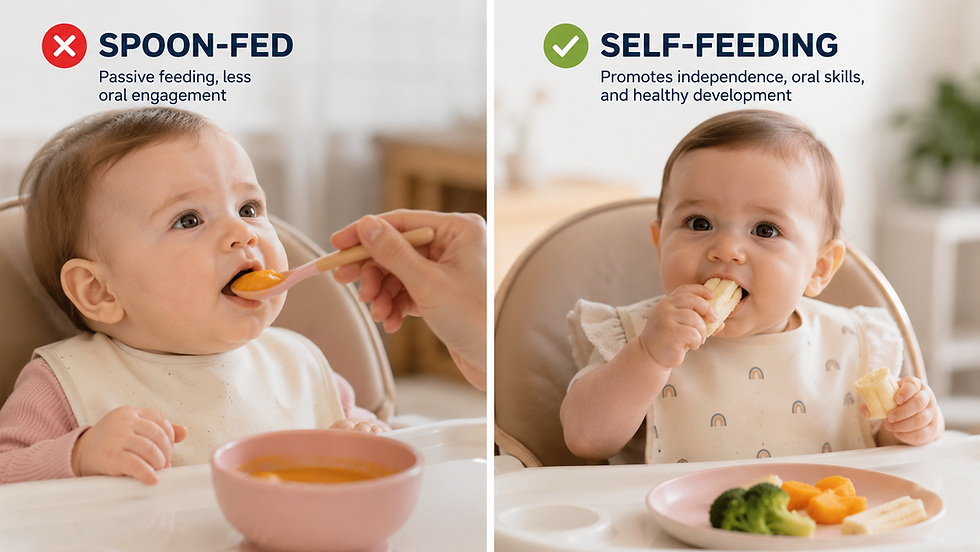
In many parts of North America, the natural next step after bottle or breastfeeding is processed baby food. But when babies are introduced to soft, pre-pureed foods too often, their tongues don't get the same workout they would from handling raw or textured foods — and a child's lower jaw is meant to grow stronger through the act of chewing. A diet of mostly soft, pre-mashed foods gives the tongue and jaw very little work to do, and over time both get "trained" to do less.
Texture and chewing aren't the only nutritional factors at play, either — the right vitamins and minerals support strong jaw and tooth development from the inside, the same way texture does from the outside.
The Mouth-Breathing Cycle
Many children end up stuck in a pattern of breathing through their mouths — and once it starts, it tends to get worse on its own.
A cold or sinus infection blocks the nose, so a child starts breathing through their mouth to sleep. That leads to poor-quality sleep, a sore throat from the dry air, and a cranky, tired kid the next day. Well-meaning parents often respond by offering more pacifiers or bottles to soothe a fussy child — without realizing their child may be spitting the pacifier out specifically to keep their mouth open for breathing. Over time, the tongue learns to stay low to make room — sometimes held there by a restrictive tongue-tie — the palate loses its support and narrows, and the nasal airway shrinks even further, making nose-breathing harder the next time around.
Breaking the cycle usually means addressing more than one piece of it at once: myofunctional therapy to retrain the tongue and lips to rest and breathe correctly, and in many cases, MARPE expansion to widen a palate that's already narrowed.
Two Checks You Can Do at Home Tonight
Neither of these replaces a professional evaluation, but both are simplified versions of tools airway-focused dentists actually use.

1. The Profile Line
Take a clear side-profile photo of your child and print it.
Using a ruler, draw a straight line from the forehead down through the point where the upper lip meets the base of the nose.
Extend that line down to the chin.
If the chin touches or extends beyond the line, that's a good sign. If it falls behind the line, it may indicate an under-developed jaw — worth a conversation with your child's dentist.

2. The Open-Mouth Check (Mallampati Score)
Have your child sit up, face you, open their mouth wide, and place the tip of their tongue on their lower front teeth. Compare what you see to the four classes doctors use to evaluate airway size:
Class 1 is a clear view and a healthy airway. Classes 2 through 4 show progressively more of the airway obstructed by the back of the tongue — and are worth a follow-up with a dentist or physician trained in airway evaluation.
Warning Signs to Watch For
Snoring or apnea pauses — any regular snoring, gasping, or pauses in breathing during sleep.
Crowded or overlapping teeth — upper teeth with little room to come in straight.
A receding or “stunted” chin — often where the lower jaw and tongue are crowding the throat.
Noisy, effortful breathing — sucking or gulping sounds while asleep.
Mouth open at rest — lips parted during the day, not just while sleeping.
Dry, swollen tonsils — a common result of breathing dry mouth-air all night.
Why Timing Matters
Guided growth treatment works with a child's natural development window — not against it. Head and neck growth is heavily front-loaded:

The earlier a narrow airway is caught, the more of it can still be corrected. That's why we say we aren't just straightening teeth — we're growing airways.
For many children — and plenty of teens and adults too — that correction comes through MARPE expansion: a custom, screw-anchored appliance that gently widens a narrow upper jaw, creating room for the airway and the adult teeth at the same time, often without extractions. It may be necessary when the palate has already narrowed enough to crowd the nasal airway or the incoming teeth, and guided growth alone isn't enough to correct it. For patients who also need their teeth straightened, we offer MASPE+, which combines that same jaw expansion with Invisalign® — widening the jaw and guiding the teeth into their final position at the same time, in one coordinated course of treatment.
Where Do We Go From Here?
Whether your child is just beginning to show signs or has struggled for years, at Westwood and Starwood Dental we are trained in airway health and can help — not just manage the problem, but reverse it.
Emily and Hema, registered dental hygienists at Westwood Dental, and Terrilynn, registered dental hygienist at Starwood Dental, are our in-house myofunctional therapists — each trained to assess a child's oral function and guide a family through the therapy and referrals that follow. They're ready to help.


Curious what myofunctional therapy actually looks like? Watch Emily walk through it and watch Emily explain what Myofunctional Therapy is in under 30 seconds
Ready to Help Your Child Breathe and Sleep Better?
If any of this sounds familiar, you don't have to figure it out alone. Our team at Westwood & Starwood Dental is trained in airway health and can help you get a clear picture of what's going on — and a plan for what to do next.
Contact us to book an airway evaluation, or call us directly:
Westwood: 519-836-4650 · Starwood: 519-766-1000
Westwood & Starwood Dental · Whole-Body Dentistry · Guelph, Ontario


We're always surprised how many boxes get checked on this one. If more than one sounds familiar, it doesn't mean anything is "wrong" — just worth a conversation.